Questioning Your Gender: How to Safely Explore Your Identity
As a gender therapist in Minneapolis, I've sat with clients who've shared how scary, exciting, and confusing it feels to question their gender. Maybe you've found yourself wondering "What if I'm not who I assumed I was?" or "Does everyone think about gender this much?" Perhaps you think about how if you woke up tomorrow as a different gender, you’d be completely happy with that, or you've spent hours researching what it means to be nonbinary, trans, or gender nonconforming.
If you're questioning your gender, you're not alone. And no, questioning your gender doesn't mean you're just confused or making it up. It means you're brave enough to explore something deeply personal about yourself, even when it feels uncertain or overwhelming.
Let's explore what it means to question your gender and how you can do so in a way that feels safe and affirming for you.
What Does It Mean to Be Questioning Your Gender?
Gender questioning is the process of exploring whether the gender you were assigned at birth truly fits who you are. It might look like wondering if you're trans, nonbinary, genderfluid, or another gender identity. For some people, questioning gender happens suddenly, a moment of clarity that makes everything click into place. For others, it's a slow unfolding over months or years.
There's no one "right" way to question your gender. Some people know from a young age that their assigned gender doesn't fit, while others don't start questioning until adolescence, adulthood, or even later in life. Both experiences are valid.
What's important to understand is that questioning your gender is not the same as being confused. You're not making it up for attention. You're engaging in a deeply personal exploration of who you are. That takes courage.
What to Do When Questioning Your Gender
If you're questioning your gender, you might feel pressure to have all the answers right now. You don't. Gender exploration is a journey, not a destination, and you get to move at your own pace.
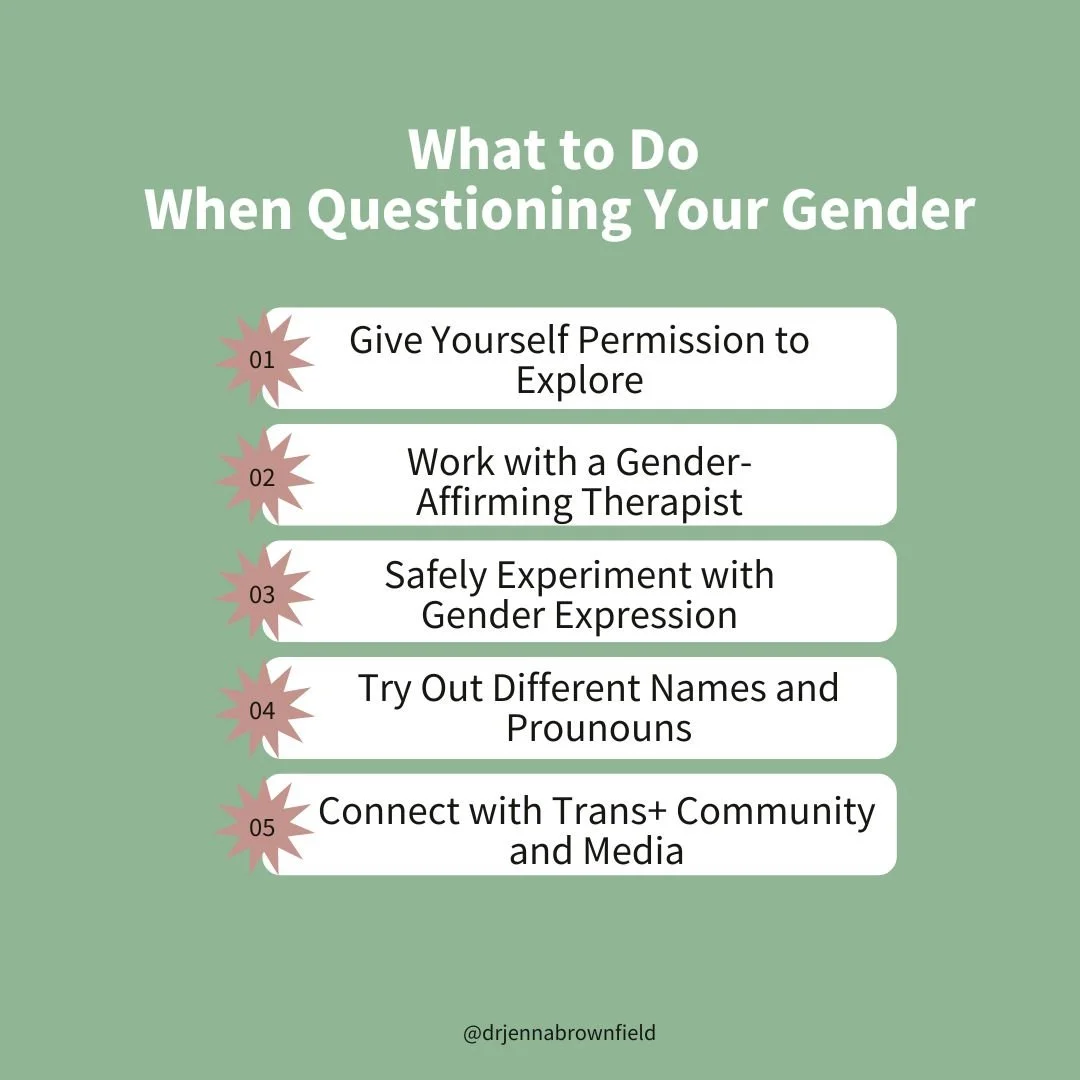
Give Yourself Permission to Explore
The first and most important thing you can do is give yourself permission to question. You don't need to have everything figured out before you're "allowed" to explore your gender. You don't need to prove anything to anyone.
You don't have to come out publicly, make any big changes, or even land on a specific label right away. Exploration can be private and personal. It's about getting to know yourself better.
Consider Working with a Gender-Affirming Therapist
A gender-affirming therapist can provide a confidential space to explore your questions without judgment. They won't pressure you to identify a certain way or rush you toward any particular outcome. Instead, they'll help you explore what feels true for you.
Experiment with Gender Expression in Safe Environments
One way to explore your gender is through expression. This might look like:
Trying different clothing styles, makeup, or accessories in the privacy of your own space or with trusted friends.
Experimenting with your hair (wigs can be a great low-commitment option)
Playing with different ways of moving or carrying yourself
Exploring gender expression through art, writing, creative projects, or avatars online
Remember, gender expression and gender identity are different things. You can express your gender in any way that feels good to you, regardless of your identity. A woman can have short hair and wear masculine clothing. A nonbinary person doesn’t have to present androgynously. There's no wrong way to express yourself.
Try Out Different Names and Pronouns
If you're curious about different names or pronouns, there are safe ways to explore:
Ask trusted friends to use different pronouns or a chosen name when you're together
Use online spaces or gaming communities to try out a new name
Practice introducing yourself with different pronouns in front of a mirror
Use a new name on something you’re having delivered to your place. Then see how it feels when you receive that mail/package and see your new name.
You might find that some pronouns or names feel amazing, some feel neutral, and some feel wrong. All of that information is valuable. And if something doesn't feel right, you can always try something different. Exploring is not the same as committing.
Connect with Trans/Nonbinary Community and Media
Finding community with other trans, nonbinary, and gender questioning folks can be incredibly affirming. You might:
Join online forums, Discord servers, or social media groups for trans and nonbinary people
Attend local LGBTQ+ support groups or community events
Follow trans and nonbinary creators or public figures who share their experiences
Read memoirs or watch documentaries by trans and nonbinary people
Seeing the diversity of trans and nonbinary experiences can help you realize there's no single way to be trans or nonbinary. You don't have to fit a specific mold.
Questions to Ask Yourself When Questioning Your Gender
As you explore your gender, these questions can help guide your reflection. Remember, there are no right or wrong answers. You don't need to answer all of them, and your answers might change over time, that's okay.
About Your Experience:
When do I feel most like myself?
Are there times when being seen as my assigned gender feels uncomfortable or wrong?
Do I ever feel disconnected from my body? If so, when?
What would it feel like to be seen as a different gender?
Do I feel excited, relieved, or curious when I imagine other people addressing me as a different gender?
Have I ever felt like I was performing or pretending when expressing my assigned gender?
About Your Feelings:
When I think about different gender identities, which ones feel like "home" to me?
Does the idea of being trans, nonbinary, or genderfluid bring me relief, excitement, or a sense of rightness?
What would I do with my gender expression if I knew nothing bad would happen and no one would judge me?
How do I feel when I hear my current name and pronouns versus other options?
About Your Body:
Are there aspects of my body that cause me distress related to gender?
Do I experience gender dysphoria, and if so, what does that feel like for me?
Would I feel more comfortable with my body if certain aspects were different?
If I suddenly had a HRT prescription in hand, would I use it?
Do I find myself envious of how people of another gender get to present themselves?
You don't need dysphoria to be trans or nonbinary, but many trans folks do experience it. If you're experiencing distress about your body or how others perceive your gender, that's important information.
Remember, these questions are meant to invite curiosity, not create pressure. Some days you might have clear answers, and other days you might feel uncertain. Both experiences are part of the process.
How to Tell Someone You're Questioning Your Gender
Sharing that you're questioning your gender can feel incredibly vulnerable. You might worry about being judged, dismissed, or told you're "just going through a phase." Here's how to approach these conversations in a way that protects your wellbeing.
Choose Your Person Thoughtfully
You don't owe anyone information about your gender exploration. You get to be selective about who you share this with. Start with people who have shown themselves to be LGBTQ+ affirming. This might be a close friend, a sibling, a partner, or a gender-affirming therapist.
Ask yourself: Has this person been supportive of LGBTQ+ people in the past? Do they respect boundaries? Will they honor my privacy and not share this with others without permission?
You Don't Have to Have All the Answers
When you tell someone you're questioning your gender, they might immediately ask questions like "So are you trans?" or "What pronouns should I use?" It's okay to say "I don't know yet. I'm still figuring it out."
You might say something like:
"I've been questioning my gender lately, and I wanted to share that with you. I don't have all the answers yet, but it would mean a lot to have your support as I explore this."
"I'm not sure what this means for me long-term, but I wanted you to know I'm thinking about my gender in new ways."
Set Boundaries Around Questions
Some people will be curious and ask lots of questions. While some questions might feel supportive, others might feel invasive. You get to set boundaries about what you're comfortable discussing.
If someone asks something too personal, you can say:
"I'm not ready to talk about that yet."
"That feels too private to share right now."
"I'm still figuring that out for myself."
Prepare for Different Reactions
Hopefully, the person responds with support and curiosity. But sometimes people react with confusion, questions, or even defensiveness. This doesn't necessarily mean they won't eventually be supportive—they might just need time to process. If their reaction is hurtful, remember that their response says more about them than it does about the validity of your questions.
Consider Starting Online
If telling someone face-to-face feels too intimidating, you might try sharing in an online LGBTQ+ space first. Anonymous forums or support groups can give you practice articulating your experience before sharing with people in your offline life.
If you're worried about your family's reaction, you might find it helpful to prepare yourself emotionally.
Questioning Your Gender FAQs
-
Not everyone questions their gender, but many people do at some point in their lives. Many cisgender people go through their lives without deeply examining their gender because their assigned gender feels right to them. However, some cis people do question their gender at some point: they explore, reflect, and ultimately realize they're comfortable with their assigned gender. For others, gender questioning is more persistent and leads to realizing they're trans, nonbinary, or another gender identity.
What's important to understand is that questioning your gender doesn't automatically mean you're trans or nonbinary. But it's also worth noting that most cisgender people don't spend significant time persistently questioning their gender or imagining what it would be like to be a different gender.
If you find yourself repeatedly coming back to questions about your gender, feeling curious about different identities, or experiencing discomfort with your assigned gender, these are meaningful feelings worth exploring, even if you're not sure where that exploration will lead. The fact that you're thinking about this deeply likely means it’s something worth really listening to.
-
Yes, it's possible to question your gender and ultimately realize you're cisgender. Some people explore their gender and discover that while they might not fit gender stereotypes, they do identify with their assigned gender. Others might identify as gender nonconforming while still being cis. The questioning process itself can be valuable regardless of where you land. It can help you understand yourself better, challenge societal expectations about gender, and develop more empathy for gender-diverse people.
However, if you're reading this and a part of you is hoping to hear that you're "just cis," I want you to consider why you're hoping for that answer. Is it because you genuinely feel comfortable with your assigned gender? Or is it because you're scared of what it might mean if you're not cis?
Many of my gender therapy clients spend time hoping they're wrong about being trans or nonbinary because the idea feels scary or overwhelming. That fear makes sense, coming out as trans or nonbinary comes with real challenges. But avoiding the question won't make those feelings go away.
Closing Thoughts on Questioning Your Gender
Questioning your gender can bring up intense emotions like excitement, fear, relief, confusion, grief, and joy, sometimes all at once. All of these feelings are valid.
Remember: You don't have to have all the answers today. Gender exploration is a journey, and it's okay if that journey takes time. It's okay if you try on different identities and change your mind. It's okay if you need space to sit with uncertainty.
What matters most is that you're being honest with yourself and giving yourself permission to explore who you truly are. That courage, even when it feels like fear, is something to be proud of.
You deserve to feel at home in your gender. You deserve to live authentically. And you deserve support as you figure out what that looks like for you.
If you're looking for a safe space to explore your gender identity with a therapist who understands the complexities of questioning, I'm here. As a trans-affirming therapist in Minneapolis, I provide online therapy throughout Minnesota and 40+ Psypact States for people exploring their gender identity. Together, we can create space for you to explore who you are at your own pace.
You deserve to feel at home in yourself. Let's work together to get you there.
And if you have transphobic family making it harder for you to explore your gender identity, grab my free guide below.
